
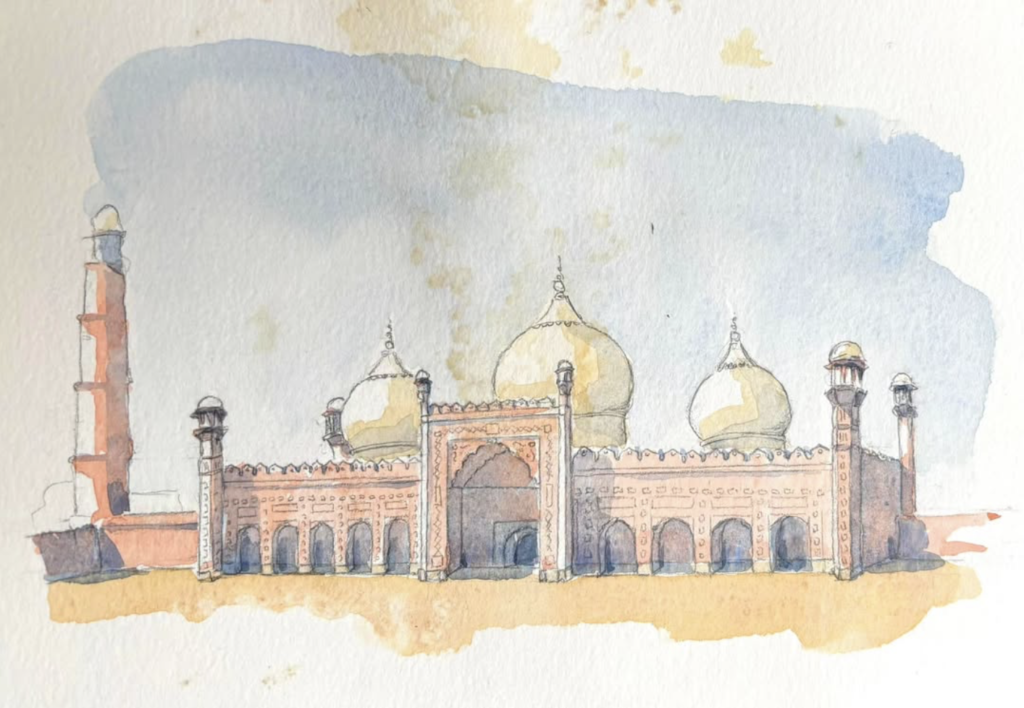
Commissioned by the Mughal emperor Aurangzeb and completed in 1673, the Badshahi Mosque in Lahore represents the high points of Mughal imperial architecture. At the time of its construction, it was the largest mosque in the world, capable of accommodating over 100,000 worshippers.
Aurangzeb ruled the Mughals at the peak of their territorial extent and economic wealth. Commanding a GDP equaling roughly one-quarter of the global economy and placed as one of the world’s top industrial states, his reign represents the high point of the South Asian early modern period. Following his death, the resulting fragmentation of the empire left a divided subcontinent that was ultimately exploited and picked apart by British and other European colonial powers
Built in red sandstone with white marble inlay, the mosque draws clear inspiration from earlier Mughal monuments such as Delhi’s Jama Masjid, while amplifying their scale and monumentality. The building clearly draws from the Persian origin of the Mughal rulers whilst presenting a material pallette more south Asian in expression.
The visual impact of the structure is somewhat negated by my spilling of coffee upon the page minutes before I was about to photograph it.